 Lincoln Laboratory engineers,
  admissions officers, and Ivy League counselors. Proud partner of The Haq Foundation. Lincoln Laboratory engineers, admissions officers, and Ivy League counselors. Proud partner of The Haq Foundation.
Sol handles the research, tracking, preparation and first-pass work that grows with every student, so your hours stay focused on the work families actually hired you for. One counselor carried 200 students on Sol last cycle, with no drop in quality, placing students in nearly every top 100 school in the country.
Your judgment. Your strategy. Your relationship with the student.
Every student gets free access to the same college application workspace already used by 50,000+ students to manage their profile, college list, activities, essays, deadlines and applications.
As they use it, everything updates automatically on your side. A school gets added, a draft changes, a form gets submitted, an activity gets updated, it is already in the student record when you open it.
No intake forms to chase. No status emails. No spreadsheet to keep current. No asking students what changed since last week.
They manage their application. Your CRM fills itself.
A sixty-minute meeting is rarely sixty minutes of work.
Before it, you review where the student left off, reopen their documents, check what changed and decide what needs to happen next.
After it, you write the recap, log the notes, update the family and keep track of everything that was just decided.
For most counselors, that is another 15 to 30 minutes around every meeting.
Multiply it across an entire roster and hours disappear before the actual counseling even begins.
Sol keeps the student record current between sessions, so you do not have to reconstruct the file every time you sit down.
There are 6,322 post-secondary institutions in the United States, with thousands of programs inside them.
Every one has its own:
They keep changing, every cycle.
Every counselor develops a set of schools they know deeply. That knowledge is enormously valuable.
No person can continuously research the entire universe for every student they advise.
Sol searches the entire space against the student in front of you, then brings the relevant options to your desk.
You make the call. You are simply making it from a much larger field of view.
The limit is not your judgment. It is how much of the universe one person can possibly know.
Sol does not just check spelling and grammar. It works through the application with the student like another counselor would.
It gets to know them, asks the questions that uncover what matters, helps discover the stories worth telling, works through which parts of themselves different schools should see, researches the college list, reads every draft, pressure-tests the ideas and keeps the entire application current as it develops.
By the time the file reaches you, the student has already had a full first counselor working with them.
You are not starting with raw material. You are looking at a student who has already been questioned, researched, challenged and worked through the application in depth.
That means your time goes to the places where your judgment adds something more: the call you would make differently, the story you see that Sol missed, the family dynamic only a person in the room would notice, the moment to push and the moment to hold.
Sol does the first counseling pass. You bring the second set of eyes.
Sol can know the student, research the schools, work through the application and keep the entire process moving.
What it cannot replace is being the person in the room.
The counselor who notices hesitation before the student says anything. Who understands the parent dynamic. Who knows when to push, when to back off and when the technically correct answer is not the right answer for this student.
That is the part worth protecting.
01What stays yours
The relationship and the judgment.
The conversation with the student. The conversation with the family. The final strategic calls. When to push, when to hold, when something feels wrong and when a student needs a person rather than another answer.
02What Sol carries
Everything that does not require you to be the person in the room.
Research, college discovery, application strategy support, idea and story discovery, essay work, deadline and portal tracking, logistics, meeting preparation, record updates and the hundreds of small decisions and tasks that surround every student.
03One student, better supported
The student effectively has two counselors working the file.
Sol is always there, always caught up and able to do the work at any hour.
You bring the relationship, experience and human judgment that software cannot.
Sol does not give the student less of you. It makes sure all of your time with them goes to the parts where you matter most.
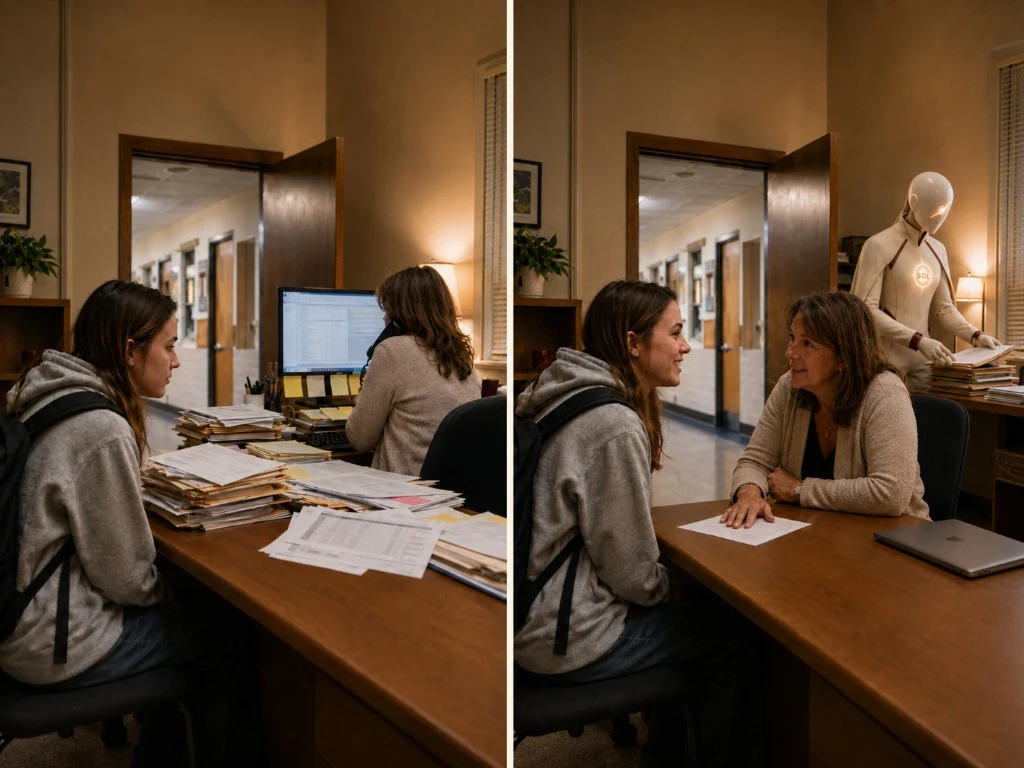
Counseling usually gets less personal as the roster grows.
More students means less time to prepare, less context in your head and more of the meeting spent asking what happened since you last spoke.
Sol reverses that.
Before you sit down with a student, you can already see what they worked on, what changed, what they submitted, what they asked, where they got stuck and what happened across their application since the last time you spoke.
You walk into the meeting already knowing the student’s world.
Instead of spending the first twenty minutes catching up, you can go straight to the thing they actually need help with.
And because Sol is carrying the research, tracking, preparation and application work around every student, you have more of your own time available for the conversation itself.
One counselor carried 200 students on Sol last cycle.
The experience did not become more industrial.
It became more personal.
More students, more context, and more time for the moments that actually need you.
Every counselor on Sol can be listed in the AdmissionsOS counselor directory, where families already researching schools, building college lists and working through the admissions process can find the right person for them.
Families can filter by the things that actually determine fit: location, specialties, student populations served, experience, practice model and price range.
Your profile also gives your practice another public page on the web, helping more families discover you through search and strengthening your online presence around the services and students you work with.
When a student reaches out, they may already have their profile, activities, college interests, financial situation, questions and progress inside Sol. If they choose to share that record with you, you can understand who they are before the first conversation even begins.
So you are not starting with a cold lead and a blank intake form.
The family finds a counselor who fits them. With their permission, you can start the relationship already understanding the student.
Students admitted to: